
Oil Painting Techniques: A Complete Guide to Painting With Oils

Updated: Sep 3
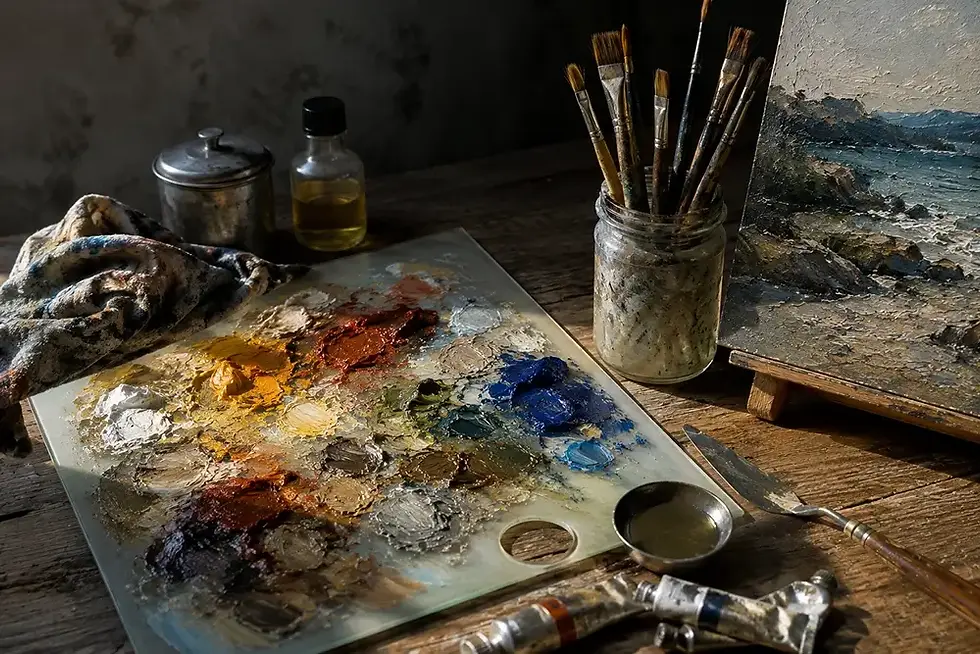
Oil paint can be used in almost opposite ways.
It can be brushed thinly and transparently, built into thick impasto, mixed directly on the canvas, or developed through layers over days, weeks, or longer.
That flexibility is one of the reasons oil painting has remained such an important medium for artists.
It is also why oil painting techniques can seem confusing. Painters encounter terms such as alla prima, glazing, scumbling, impasto, underpainting, grisaille, imprimatura, blocking-in, blending, dry brush, and fat over lean.
But learning their names is not the same as understanding them.
The useful question is not simply what oil painting techniques exist?
It is what does each technique allow the painter to do?
What Are Oil Painting Techniques?
Oil painting techniques are different ways of applying, manipulating, and building oil paint to achieve a particular visual or physical result.
Some techniques describe how paint is applied. Others describe how a painting is constructed.
For example, impasto refers to the substantial physical thickness of paint. Glazing uses transparent or translucent layers over an underlying layer. Alla prima describes painting wet into wet, while underpainting describes an early stage in constructing the image.
These techniques are not mutually exclusive.
A painter might begin with an imprimatura, establish a grisaille or color underpainting, develop the painting through opaque layers, use glazing to modify selected passages, and finish certain areas with impasto.
The techniques are tools. The painting determines which tools are useful.
Alla Prima: Painting Wet Into Wet
Alla prima, Italian for “at once,” is a direct approach to oil painting in which paint is worked wet into wet rather than being developed primarily through a long sequence of dried layers.
Because the paint remains workable, colors can be adjusted directly on the surface. Edges can be softened, brushstrokes can remain visible, and decisions can develop in response to one another.
This can create a sense of immediacy and freshness.
Alla prima is sometimes described as a quick or easy way to paint, but that is misleading. Working wet into wet can require considerable control because the painter has less opportunity to separate decisions into different drying stages.
Alla prima is therefore not simply a faster version of layered painting.
It is a different way of organizing the painting process. Technical conservation literature distinguishes direct, wet-into-wet approaches from indirect, multilayered approaches, while also noting that artists can combine them.
Layered Oil Painting: Building the Image Over Time
The alternative to working primarily wet into wet is to build the painting through successive layers.
A layer is allowed to dry sufficiently before another layer is developed over it.
This approach gives the painter time to separate different decisions.
One stage can establish the drawing and composition. Another can establish values. Later layers can refine color, edges, transparency, and surface.
Layered painting is particularly important when the painter wants to create effects that depend on the interaction of several distinct paint films.
Glazing and scumbling, for example, depend on an underlying layer continuing to influence the appearance of the layers above it.
Oil paint's relatively slow drying time makes this kind of gradual construction possible.
Imprimatura: Starting With a Colored Ground
An imprimatura is a thin, usually transparent or semi-transparent layer of color applied over the prepared ground before the main painting develops.
Instead of beginning against a bright white surface, the painter establishes an overall tone.
This can help reduce the visual intensity of a white ground and give the painter an initial color environment against which later mixtures can be judged.
The imprimatura can remain visible in parts of the finished painting or become almost completely covered.
It is particularly useful when the painter wants the ground itself to participate in the overall color atmosphere.
Blocking-In: Establishing the Large Shapes First
Blocking-in is the stage in which the painter establishes the major shapes, proportions, colors, and value relationships before concentrating on smaller details.
It is one of the simplest and most important oil painting techniques because it keeps the painting organized around the larger structure.
A painter who begins immediately with details can easily produce convincing individual passages that do not work together.
Blocking-in works in the opposite direction.
First establish the large masses.
Then evaluate the painting as a whole.
Only after the major relationships are working does it make sense to invest heavily in smaller details.
Blocking-in is therefore not merely a preliminary step. It is a way of thinking about the hierarchy of decisions in a painting.
Underpainting: Establishing the Foundation
An underpainting is an initial stage of painting beneath later development.
It can be monochromatic or made with several colors. It can establish values, temperature, composition, or the broad relationship between light and shadow.
A monochromatic underpainting is sometimes called a grisaille when it is developed primarily through values of gray or a limited neutral range.
Historically, underpainting methods could serve as a structural stage before later layers were added. Modern painters may use the same idea more freely, allowing parts of the underpainting to remain visible.
The important point is that an underpainting does not have to disappear.
It can become part of the final painting.
Grisaille: Building Through Value
Grisaille is a painting approach based primarily on values rather than full color.
The painter establishes light, middle values, and darks before introducing or developing color.
This can help separate the problem of value from the problem of color.
For a painter struggling to judge color accurately, this separation can be useful. If the underlying structure of light and dark is convincing, later color can be developed without having to solve every visual problem simultaneously.
Grisaille can also be used as part of an indirect painting process, where transparent or semi-transparent color is later developed over the established value structure.
Glazing: Building Color Through Transparency
Glazing involves applying a transparent or translucent layer of paint over a sufficiently dry underlying layer.
Because the lower layer remains visible through the upper one, the final color is produced by the interaction of the layers rather than by simply mixing the two colors together on the palette.
Glazing can be used to:
deepen a color
shift its temperature
modify a shadow
enrich a passage
create optical depth
change an existing color without completely covering it
The technique is fundamentally different from ordinary palette mixing.
When two colors are mixed together physically, they form a new mixture within one paint layer.
With glazing, the visual effect comes from layers remaining optically distinct.
This is one of the reasons glazing has been so important in the history of indirect oil painting.

Scumbling: Breaking the Surface Color
Scumbling is different from glazing.
Instead of applying a transparent layer, the painter applies a relatively thin, often opaque or semi-opaque layer in a broken manner so that parts of the underlying color remain visible.
The brush does not necessarily cover the surface evenly.
This can create subtle transitions, atmospheric effects, textured passages, and variations in color.
Scumbling is especially useful when the painter wants the layer underneath to remain an active part of the visual result without using a transparent glaze.
Glazing and scumbling are therefore useful techniques to understand together:
Glazing reveals the layer beneath through transparency. Scumbling reveals it through broken coverage.
Impasto: When Paint Becomes Part of the Image
Impasto is the application of paint in substantial thickness so that the physical surface of the paint becomes part of the visual experience.
Brush marks, ridges, peaks, and palette-knife marks may remain visible.
The viewer is not only seeing an image.
They are also seeing the material from which the image is made.
Impasto can be used across an entire painting or reserved for selected passages.
A painter might use thick paint for highlights, important edges, expressive brushwork, or areas where physical texture contributes to the subject.
A palette knife is particularly useful for impasto, but impasto does not require a knife. Thick paint can be built with brushes as well.
Blending: Softening Transitions
Blending creates a gradual transition between colors or values.
It can be useful when painting rounded forms, subtle changes of light, or soft transitions between adjacent colors.
But blending is not automatically better than visible brushwork.
A painting can contain hard edges, soft edges, broken edges, and lost edges. These differences help establish form and direct the viewer's attention.
If every transition is blended equally, the painting can become visually flat.
Good oil painting is therefore not about making every brushstroke disappear.
It is about deciding which transitions should be soft and which should remain clear.
Dry Brush: Letting the Surface Show Through
With dry-brush painting, relatively little wet paint is carried by the brush, allowing the texture of the surface to break up the mark.
Instead of creating a continuous film, the brush leaves a fragmented stroke.
Dry brush can be useful for:
textured surfaces
hair
foliage
atmospheric effects
broken edges
modifying an existing layer without completely covering it
It is another example of how oil painting technique is partly about controlling what remains visible.
The painter is deciding not only what color to add, but how much of the surface beneath it should remain part of the image.
Palette Knife Painting
A palette knife can be used to apply, spread, scrape, remove, or reshape oil paint.
Because the knife behaves differently from a brush, it encourages a different kind of mark.
It can create broad planes, sharp edges, thick passages, and scraped surfaces.
Palette knife painting is often associated with impasto, but the two are not identical.
A knife can apply relatively thin paint, while a brush can create very thick impasto.
The importance of the palette knife is therefore not simply the texture it produces.
It changes the physical relationship between the painter and the paint.
Direct Painting vs. Indirect Painting
Two broad approaches help make sense of many oil painting techniques: direct painting and indirect painting.
In direct painting, the visual result is developed largely through the paint that is visible on the surface. Alla prima is a major example.
In indirect painting, the final appearance is developed through multiple layers, with earlier layers continuing to influence the appearance of later ones. Glazing is a central example.
These approaches are not rigid categories.
A painter can combine them within the same work.
A painting might begin with a structured underpainting, develop through opaque direct painting, and later receive transparent glazes.
The distinction is useful because it helps explain why different techniques produce different kinds of surfaces and color relationships.
Fat Over Lean: What the Rule Actually Means
Fat over lean is one of the most repeated rules in oil painting, and also one of the most misunderstood.
"Fat" does not mean thick paint.
It refers primarily to the relative amount of drying oil in the paint layer. "Lean" refers to a layer with less oil relative to the fat layer above it. Traditional oil-painting systems use the principle when constructing separate layers because the paint film changes as the oil binder oxidizes and hardens.
The basic idea is to build successive layers so that upper layers are not significantly less flexible than the layers beneath them.
However, the simple phrase can become misleading when applied mechanically to every modern oil-painting medium.
Drying behavior depends on more than the amount of added oil. Pigment, layer thickness, binder, medium, and formulation all influence how quickly a layer dries and how it behaves.
This is why "fat over lean" should be understood as a principle of layer structure and material behavior, not as a rule about making every successive layer physically thicker or simply adding more oil.
Conservation documentation shows that failures in layer structure can contribute to cracking, flaking, and paint loss.

Oiling Out: Restoring a Dull Surface
Oiling out is another term painters encounter when working with layered oil paint.
Some areas of an oil painting can appear noticeably duller or lighter after drying. This is often referred to as sinking in.
Winsor & Newton explains that this can occur when oil is absorbed into an absorbent surface or lower layer, leaving some areas looking matte or lacking depth.
Oiling out involves applying a very thin amount of an appropriate oil or medium to the affected area to restore a more even surface appearance before continuing or, in appropriate cases, before varnishing.
It should not be treated as something every oil painting automatically requires.
The first question is whether there is actually a problem with uneven absorption or dullness.
How Do You Choose the Right Oil Painting Technique?
The right technique depends on the visual problem.
If the main problem is structure, begin with blocking-in.
If you need to establish an overall value or color foundation, consider an underpainting or grisaille.
If you want to work directly with wet paint, alla prima may be appropriate.
If you want to construct color gradually through transparent layers, glazing offers a different approach.
If you want broken, textured color, scumbling may be useful.
If the physical surface of the paint should become part of the image, consider impasto.
If a transition needs to be gradual, blending may help.
If you want the surface texture to break up the mark, try dry brush.
If you want broad, direct marks or need to scrape and manipulate paint, a palette knife can be useful.
The question is not:
Which technique is the best?
The better question is:
What does this particular passage of the painting need?
Can You Combine Different Oil Painting Techniques?
Yes—and painters often do.
A single painting can contain several different approaches.
For example, a painter might begin with an imprimatura, establish the composition through blocking-in, develop the values with an underpainting, paint major forms directly, use glazing in selected areas, scumble highlights, and finish with impasto.
There is no requirement for the entire painting to obey one technique.
In fact, the ability to combine techniques is one of the strengths of oil paint.
Different parts of a painting can require different solutions.
The important thing is that the techniques work together rather than becoming a collection of effects.
The Goal Is Not to Collect Techniques
It is easy to approach oil painting as if becoming a better painter means learning more techniques.
But technique is only valuable when it improves a decision.
Knowing how to glaze does not automatically create depth.
Knowing how to blend does not automatically create convincing form.
Knowing how to use impasto does not automatically create expressive brushwork.
The deeper skill is knowing when to use a technique—and when not to use it.
A painter who understands how oil paint behaves can choose deliberately.
Sometimes the best solution is a transparent glaze.
Sometimes it is a thick, direct stroke.
Sometimes it is a broken scumble.
Sometimes it is to leave the underpainting visible.
And sometimes the most effective decision is simply to put down one clear stroke and stop.
Final Thoughts
Oil painting techniques are not a collection of tricks to memorize.
They are different ways of controlling paint, layers, transparency, opacity, texture, edges, and time.
Alla prima offers immediacy.
Layering offers gradual construction.
Underpainting establishes a foundation.
Glazing modifies color through transparency.
Scumbling creates broken surface relationships.
Impasto makes the physical paint part of the image.
Blending controls transitions.
Dry brush uses the texture of the surface.
And fat over lean reminds the painter that the structure of the paint film matters as much as the appearance of the individual stroke.
Once these techniques are understood as solutions to different painting problems, they become much more useful.
The goal is not to make every painting demonstrate how many techniques you know.
The goal is to understand what oil paint can do and choose the method that allows the painting to say what it needs to say.
Go deeper into the world of painting.
Discover more artists, ideas, and perspectives for your own practice.
Explore Introspective Art


Comments